Header Bidding Ad Networks: Complete Guide for Publishers in 2024
Master header bidding ad networks to maximize revenue. Learn implementation, benefits, challenges, and best practices for publishers and ad ops teams.
Header Bidding Ad Networks: Complete Guide for Publishers in 2024
Header bidding has revolutionized programmatic advertising, transforming how publishers monetize their inventory and how advertisers compete for ad placements. As traditional waterfall setups give way to simultaneous auctions, understanding header bidding ad networks has become crucial for publishers seeking to maximize their revenue potential.
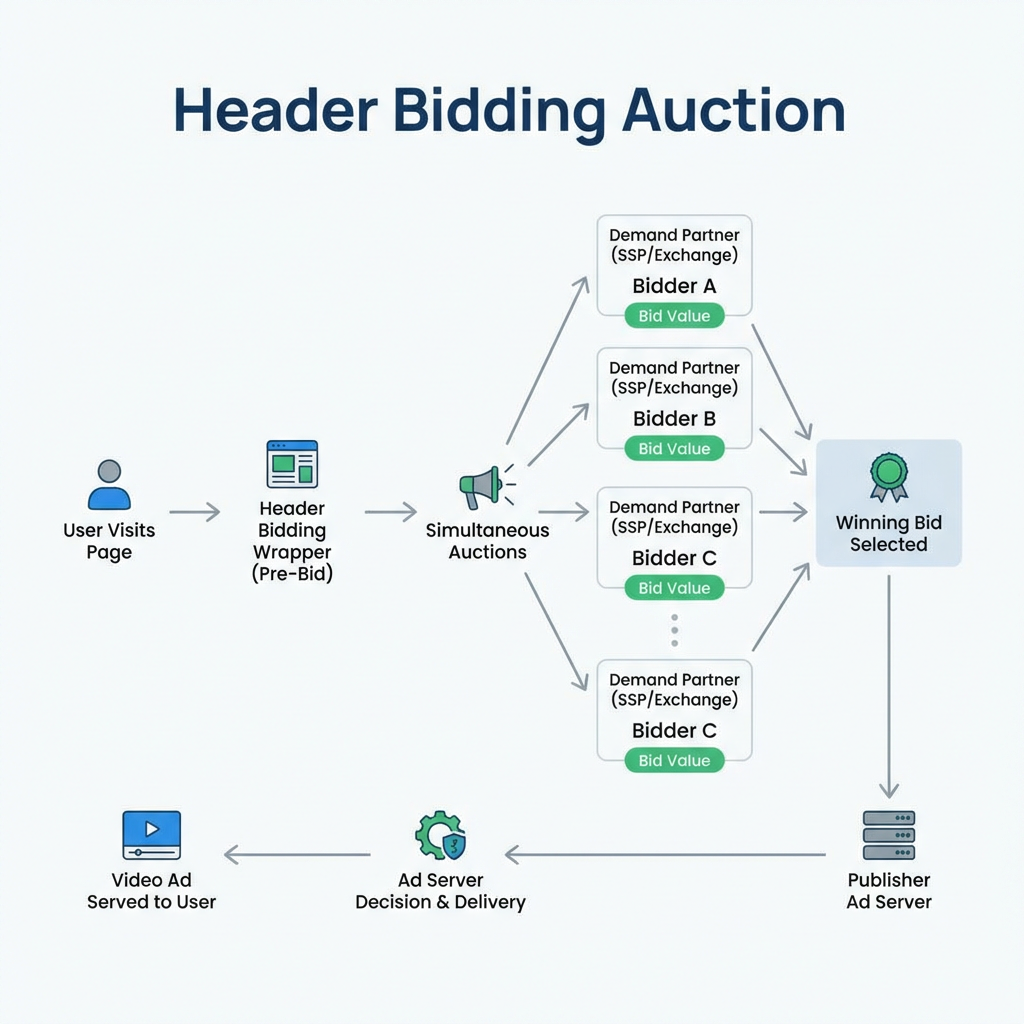
What Are Header Bidding Ad Networks?
Header bidding ad networks are demand partners that participate in real-time auctions conducted directly within a publisher's webpage before the primary ad server is called. Unlike traditional programmatic setups where demand sources compete sequentially, header bidding enables multiple ad networks, exchanges, and demand-side platforms (DSPs) to bid simultaneously on available inventory.
The process occurs through JavaScript code placed in the website's header, hence the name "header bidding." This code allows multiple demand sources to evaluate and bid on ad impressions in parallel, creating a more competitive environment that typically results in higher CPMs and increased revenue for publishers.
Key Components of Header Bidding
- Wrapper Technology: The JavaScript framework that manages auction timing and demand partner integration
- Demand Partners: Ad networks, exchanges, and SSPs that participate in the auction
- Price Granularity: The level of detail in bid price reporting back to the ad server
- Timeout Settings: The maximum time allowed for bidders to respond before the auction concludes
How Header Bidding Ad Networks Operate
The Auction Process
When a user visits a webpage with header bidding implemented, the following sequence occurs:
- Page Load Initiation: The browser begins loading the webpage and encounters the header bidding code
- Bid Request Generation: The wrapper sends bid requests to all configured demand partners simultaneously
- Partner Response: Each demand partner evaluates the impression and returns their bid (or passes)
- Price Competition: All returned bids are compared to determine the highest offer
- Ad Server Integration: The winning bid price is passed to the primary ad server as a key-value pair
- Final Auction: The ad server conducts its final auction, comparing header bidding winners against direct deals and house ads
- Ad Rendering: The winning creative is displayed to the user
Real-Time Decision Making
Header bidding ad networks must make bidding decisions within extremely tight timeframes, typically 1-2 seconds. This requires sophisticated algorithms that can quickly assess:
- User demographics and behavior patterns
- Historical performance data for similar inventory
- Current campaign budgets and pacing requirements
- Competitive landscape and bid density
- Expected conversion rates and advertiser ROI
Benefits for Publishers
Increased Revenue Opportunities
The primary advantage of header bidding ad networks is the potential for increased ad revenue. By enabling simultaneous competition among multiple demand sources, publishers often see CPM increases of 20-50% compared to traditional waterfall setups.
Revenue Impact Factors:
- Greater demand density leading to more competitive auctions
- Elimination of the "first look" advantage previously held by preferred partners
- Better price discovery through transparent competition
- Reduced unsold inventory through increased fill rates
Enhanced Transparency and Control
Header bidding provides publishers with unprecedented visibility into their programmatic operations:
- Bid-level reporting showing exactly what each partner is willing to pay
- Performance analytics enabling data-driven optimization decisions
- Partner comparison tools for evaluating demand source effectiveness
- Real-time monitoring of auction dynamics and partner participation
Reduced Dependency on Single Partners
Traditional publisher monetization often created unhealthy dependencies on primary ad networks. Header bidding diversifies revenue streams by:
- Enabling easy testing of new demand partners
- Reducing negotiation leverage imbalances
- Creating backup revenue sources if primary partners underperform
- Facilitating rapid partner replacement when necessary
Implementation Strategies
Choosing the Right Header Bidding Solution
Publishers have several implementation options, each with distinct advantages:
Client-Side Implementation:
- Faster setup and deployment
- Greater publisher control over auction parameters
- Direct integration with existing ad operations workflows
- Potential page latency impact requiring careful optimization
Server-Side Implementation:
- Reduced page load impact
- Better user experience on mobile devices
- Centralized auction management
- Less granular publisher control over individual auctions
Hybrid Approaches:
- Combines benefits of both client-side and server-side methods
- Enables partner-specific routing based on performance characteristics
- Requires more complex setup and ongoing management
- Optimal for large publishers with dedicated ad ops teams
Partner Selection Criteria
Successful header bidding implementation requires careful demand partner selection:
Performance Metrics:
- Bid rate (percentage of auctions where partner submits bids)
- Win rate (percentage of submitted bids that win auctions)
- Average CPM and eCPM contribution
- Fill rate across different inventory types
Technical Considerations:
- Response time and timeout compliance
- Integration complexity and support quality
- Reporting capabilities and data granularity
- Mobile optimization and compatibility
Business Factors:
- Revenue share terms and payment schedules
- Minimum traffic requirements and exclusivity clauses
- Geographic coverage and advertiser diversity
- Brand safety measures and content policies
Video Advertising Integration
Video inventory presents unique header bidding opportunities and challenges. Publishers using video players like Veedmo can implement header bidding for video ad slots, though this requires specialized consideration of video-specific factors:
- Format compatibility with VAST, VPAID, and other video ad standards
- Bandwidth optimization to prevent buffering issues
- Mobile responsiveness for cross-device video experiences
- Ad pod management for mid-roll and pre-roll placements
Common Challenges and Solutions
Page Latency Management
One of the most significant concerns with header bidding implementation is potential impact on page load times. Effective latency management requires:
Timeout Optimization:
- Setting appropriate timeout values (typically 1000-2000ms)
- Regular monitoring and adjustment based on partner performance
- Geographic timeout variations to account for server distance
Asynchronous Loading:
- Implementing non-blocking JavaScript execution
- Prioritizing above-the-fold ad slots
- Using lazy loading for lower-priority inventory
Partner Performance Monitoring:
- Identifying and removing consistently slow partners
- Implementing dynamic timeout adjustments
- Regular performance audits and optimization cycles
Ad Quality and Brand Safety
Increased demand diversity can introduce ad quality challenges:
Quality Control Measures:
- Implementing robust creative scanning and approval processes
- Establishing clear content policies and enforcement mechanisms
- Regular audit of partner compliance and advertiser quality
Brand Safety Protocols:
- Category-based blocking for sensitive content
- Advertiser whitelists and blacklists
- Real-time creative analysis and blocking capabilities
Technical Integration Complexity
Header bidding implementation can be technically demanding:
Development Resources:
- Adequate technical expertise for initial setup and ongoing optimization
- QA processes for testing across devices and browsers
- Monitoring systems for identifying and resolving issues quickly
Ongoing Maintenance:
- Regular wrapper updates and security patches
- Partner integration updates and new feature adoption
- Performance monitoring and optimization workflows
Performance Optimization Best Practices
Auction Configuration
Optimal header bidding performance requires careful auction configuration:
Price Granularity Settings:
- Dense granularity for high-value inventory
- Coarse granularity for lower-value traffic
- Custom granularity buckets for specific revenue optimization
Demand Partner Management:
- Regular performance evaluation and partner rotation
- A/B testing of different partner combinations
- Geographic and device-specific partner optimization
Data and Analytics
Effective header bidding optimization relies heavily on data analysis:
Key Performance Indicators:
- Revenue per thousand impressions (RPM)
- Fill rate and bid rate by partner
- Page latency impact and user experience metrics
- Advertiser diversity and campaign performance
Reporting and Analysis:
- Daily performance monitoring dashboards
- Weekly partner performance reviews
- Monthly revenue optimization assessments
- Quarterly strategic planning and partner evaluation
Advanced Optimization Techniques
Dynamic Floor Pricing:
- Implementing AI-driven floor price optimization
- Geographic and temporal floor price variations
- Device and user segment-specific pricing strategies
Audience Segmentation:
- Creating high-value audience segments for premium pricing
- Partner-specific audience targeting optimization
- Cross-device user identification and targeting
Future of Header Bidding Ad Networks
Industry Evolution
The header bidding landscape continues evolving rapidly:
Technical Innovations:
- Server-side auction improvements and adoption
- Mobile-first optimization and AMP integration
- Connected TV and video advertising expansion
Privacy and Regulation:
- GDPR and CCPA compliance requirements
- Third-party cookie deprecation preparation
- First-party data strategy development
Emerging Opportunities
Connected TV Growth:
- Streaming inventory monetization expansion
- Advanced audience targeting capabilities
- Interactive and shoppable ad format development
Artificial Intelligence Integration:
- Machine learning-driven bid optimization
- Automated partner selection and management
- Predictive analytics for revenue forecasting
Header bidding ad networks have fundamentally changed programmatic advertising, creating new opportunities for publishers to maximize revenue while maintaining control over their inventory. Success requires careful implementation, ongoing optimization, and strategic partner management. As the industry continues evolving, publishers who master these fundamentals will be best positioned to capitalize on emerging opportunities and navigate future challenges.
By focusing on technical excellence, performance optimization, and strategic partner relationships, publishers can build sustainable header bidding operations that deliver consistent revenue growth while maintaining positive user experiences. The key is balancing revenue maximization with technical performance and user satisfaction – a challenge that requires ongoing attention and expertise but offers significant rewards for those who execute effectively.
Frequently asked questions
What is the difference between header bidding and traditional ad serving?
Traditional ad serving uses a sequential waterfall approach where demand sources bid one after another, while header bidding enables simultaneous auctions where multiple partners bid at the same time, typically resulting in higher CPMs and better revenue for publishers.
How much revenue increase can publishers expect from header bidding?
Publishers typically see revenue increases of 20-50% when implementing header bidding, though results vary based on current setup, demand partner selection, traffic quality, and optimization efforts.
Does header bidding slow down website loading times?
Header bidding can impact page load times if not properly implemented. However, with appropriate timeout settings (1-2 seconds), asynchronous loading, and performance monitoring, latency impact can be minimized while maintaining revenue benefits.
How many demand partners should publishers work with in header bidding?
Most publishers optimize with 8-15 demand partners. Too few partners limit competition, while too many can cause latency issues and diminishing returns. The optimal number depends on traffic volume, geographic distribution, and technical capabilities.
Is header bidding suitable for small publishers?
Yes, header bidding can benefit publishers of all sizes. Many wrapper solutions and managed services make implementation accessible for smaller publishers, though the revenue impact and complexity management vary based on traffic volume and technical resources.