Header Bidding Ads: Complete Guide for Publishers to Maximize Revenue
Learn how header bidding transforms ad revenue for publishers. Complete guide covering implementation, benefits, challenges, and best practices.
What is Header Bidding?
Header bidding, also known as advance bidding or pre-bidding, is a programmatic advertising technique that allows publishers to offer their ad inventory to multiple demand sources simultaneously before making calls to their ad server. This revolutionary approach has transformed how publishers monetize their content by creating a more competitive and transparent auction environment.
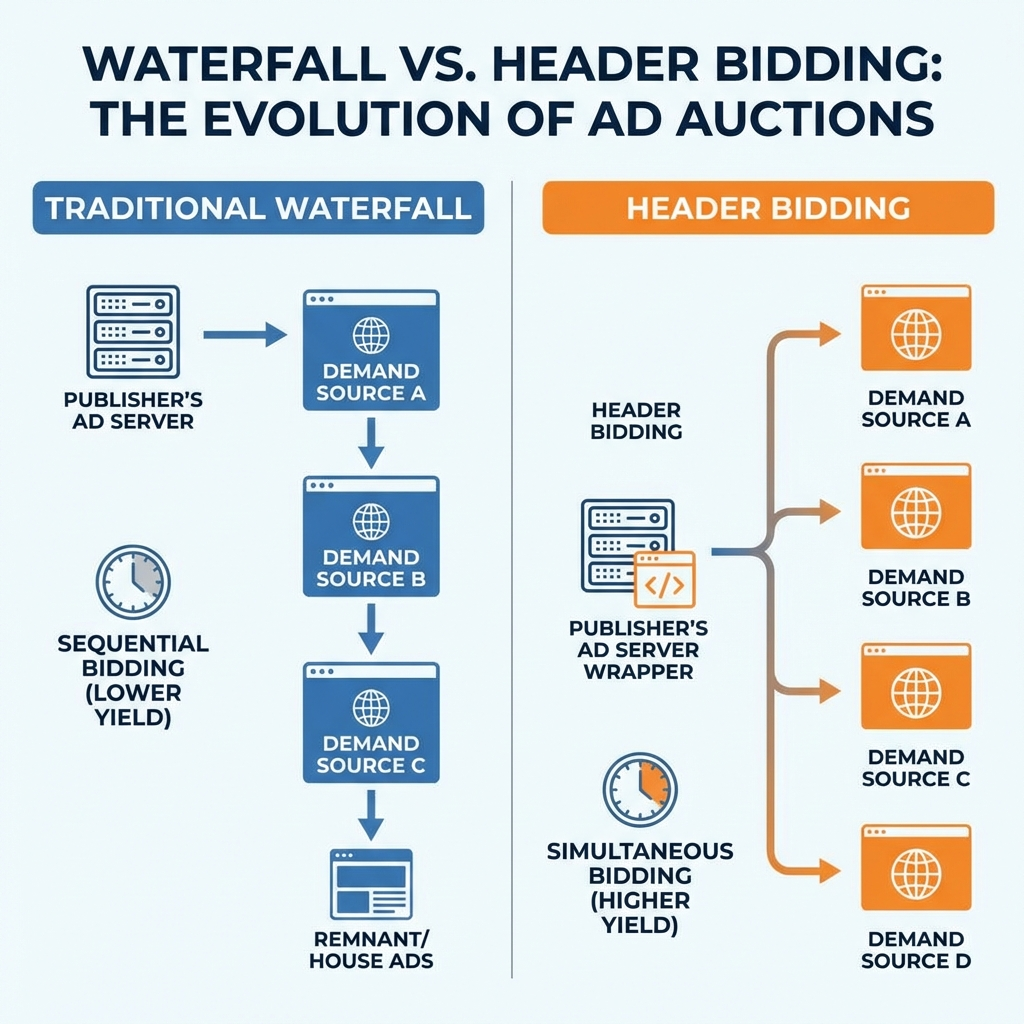
Unlike traditional waterfall setups where demand sources bid sequentially, header bidding enables all participating demand partners to compete on equal footing in real-time. This simultaneous bidding process typically results in higher fill rates, increased competition, and ultimately, better revenue for publishers.
How Header Bidding Works
The Traditional Waterfall Problem
Before header bidding, publishers relied on the waterfall method, where ad networks were prioritized in a predetermined order. The first network in line would either fill the impression or pass it down to the next network. This sequential process had several limitations:
- Revenue Loss: Higher-paying demand sources lower in the waterfall might never get a chance to bid
- Latency Issues: Each network call added loading time
- Limited Competition: Networks competed based on position rather than actual bid value
- Inefficient Fill Rates: Premium inventory might be sold to lower-paying networks
The Header Bidding Solution
Header bidding addresses these issues through a JavaScript-based auction that occurs in the user's browser before the ad server is called. Here's the step-by-step process:
- Page Load: User visits a webpage with header bidding implementation
- Auction Initiation: JavaScript code triggers simultaneous bid requests to multiple demand sources
- Bid Collection: All participating partners submit their bids within a specified timeout period
- Winner Selection: The highest bid is identified and passed to the ad server
- Final Competition: The winning header bid competes against the publisher's direct deals and house ads
- Ad Serving: The ultimate winner serves their creative to the user
Types of Header Bidding
Client-Side Header Bidding
Client-side header bidding runs entirely in the user's browser through JavaScript code embedded in the webpage header. This approach offers:
Advantages:
- Full control over the auction process
- Direct access to first-party data
- Transparency in bidding behavior
- No dependency on external servers
Disadvantages:
- Increased page latency
- Limited by browser timeout constraints
- Potential impact on user experience
- Complex implementation and maintenance
Server-Side Header Bidding
Server-side header bidding moves the auction to external servers, reducing the load on the user's browser. Benefits include:
Advantages:
- Reduced page latency
- Support for unlimited demand partners
- Better user experience
- Mobile-friendly implementation
Disadvantages:
- Less control over the auction
- Potential data loss during server transfers
- Dependency on third-party infrastructure
- Reduced access to user data
Hybrid Approach
Many publishers adopt a hybrid model, combining both client-side and server-side bidding to maximize benefits while minimizing drawbacks. This approach typically involves running high-value demand partners client-side while moving longer-tail partners to server-side auctions.
Benefits of Header Bidding for Publishers
Increased Revenue
The primary advantage of header bidding is revenue optimization. By enabling true competition among demand sources, publishers typically see:
- 10-30% revenue increase on average
- Higher CPMs due to increased competition
- Better monetization of premium inventory
- Reduced unsold inventory
Improved Fill Rates
With multiple demand sources bidding simultaneously, publishers experience:
- Higher overall fill rates
- Better coverage across different audience segments
- Reduced dependency on single demand sources
- More consistent revenue streams
Enhanced Control and Transparency
Header bidding provides publishers with:
- Real-time bidding data and analytics
- Better understanding of inventory value
- Ability to set price floors effectively
- Direct relationships with demand partners
Reduced Latency (Server-Side)
Server-side implementations can significantly improve:
- Page loading speeds
- User experience metrics
- SEO performance
- Mobile site performance
Implementation Strategies
Choosing the Right Wrapper
Publishers typically implement header bidding through wrapper solutions that manage the auction process. Popular options include:
Prebid.js: The most widely adopted open-source solution offering:
- Extensive demand partner integrations
- Active community support
- Customizable auction logic
- Comprehensive analytics
Amazon TAM (Transparent Ad Marketplace): Amazon's server-side solution providing:
- Access to Amazon's demand
- Server-side auction management
- Simplified implementation
- Built-in optimization features
Google Open Bidding: Google's server-side alternative offering:
- Integration with Google Ad Manager
- Access to Google's demand sources
- Simplified setup process
- Automatic optimization
Technical Implementation Steps
- Audit Current Setup: Analyze existing ad stack and revenue performance
- Choose Demand Partners: Select SSPs and exchanges based on audience fit
- Set Up Wrapper: Implement chosen header bidding wrapper
- Configure Timeouts: Balance revenue opportunity with user experience
- Establish Price Floors: Set minimum bid thresholds
- Testing Phase: A/B test against existing setup
- Optimization: Continuously monitor and adjust based on performance
Best Practices for Implementation
Timeout Management: Set appropriate timeout values (typically 1000-2000ms) to balance revenue and user experience.
Partner Selection: Choose 5-8 high-quality demand partners rather than maximizing quantity.
Price Floor Optimization: Regularly adjust price floors based on historical performance data.
Mobile Optimization: Consider server-side solutions for mobile traffic to minimize latency impact.
Video Integration: For video content publishers, solutions like Veedmo can be integrated with header bidding setups to maximize video ad revenue through optimized player experiences.
Common Challenges and Solutions
Latency Management
Challenge: Header bidding can increase page load times, impacting user experience and SEO.
Solutions:
- Implement server-side bidding for mobile traffic
- Optimize timeout settings
- Use lazy loading for below-the-fold inventory
- Monitor Core Web Vitals regularly
Technical Complexity
Challenge: Implementation and maintenance require significant technical expertise.
Solutions:
- Partner with experienced ad ops teams
- Use managed header bidding services
- Invest in proper monitoring tools
- Establish clear escalation procedures
Revenue Cannibalization
Challenge: Header bidding might compete with existing direct deals and private marketplaces.
Solutions:
- Properly configure deal prioritization
- Set appropriate price floors
- Segment inventory strategically
- Regular performance analysis
Data Discrepancies
Challenge: Different reporting methodologies can lead to data inconsistencies.
Solutions:
- Implement unified tracking pixels
- Establish clear attribution models
- Regular data reconciliation processes
- Use third-party verification services
Advanced Optimization Techniques
Dynamic Price Floors
Implementing dynamic price floors based on:
- Historical performance data
- Real-time market conditions
- User segment characteristics
- Inventory scarcity
Audience Segmentation
Optimizing demand partner selection based on:
- Geographic targeting
- Device type preferences
- User behavior patterns
- Content category alignment
Bid Landscape Analysis
Regular analysis of:
- Win rate optimization
- Bid density patterns
- Demand partner performance
- Revenue per thousand impressions (RPM)
A/B Testing Framework
Continuous testing of:
- Different wrapper configurations
- Timeout value adjustments
- Demand partner combinations
- Price floor strategies
Industry Trends and Future Outlook
Privacy Regulations Impact
With increasing privacy regulations like GDPR and CCPA, header bidding implementations must adapt to:
- Consent management integration
- First-party data utilization
- Cookieless targeting solutions
- Privacy-compliant tracking methods
Connected TV (CTV) Growth
Header bidding is expanding into CTV environments, offering:
- Premium video inventory monetization
- Advanced targeting capabilities
- Programmatic access to TV audiences
- Cross-device campaign optimization
Artificial Intelligence Integration
AI-powered optimization includes:
- Predictive bid floor adjustments
- Automated partner selection
- Real-time performance optimization
- Anomaly detection and alerts
Measuring Success
Key Performance Indicators
Publishers should monitor:
Revenue Metrics:
- Total ad revenue
- Revenue per visitor (RPV)
- Cost per mille (CPM) improvements
- Fill rate increases
Technical Performance:
- Page load time impact
- Timeout rates
- Error rates
- User experience metrics
Operational Efficiency:
- Setup and maintenance costs
- Time to implement changes
- Data accuracy levels
- Partner management overhead
Reporting and Analytics
Effective header bidding requires comprehensive reporting covering:
- Real-time bidding performance
- Historical trend analysis
- Partner-specific insights
- Revenue attribution models
Conclusion
Header bidding has revolutionized programmatic advertising by creating a more competitive and transparent marketplace for publishers. While implementation requires technical expertise and ongoing optimization, the potential for significant revenue increases makes it essential for most publishers.
Success with header bidding depends on choosing the right implementation approach, selecting quality demand partners, and maintaining a balance between revenue optimization and user experience. As the digital advertising landscape continues to evolve with privacy regulations and new inventory types like CTV, header bidding will remain a critical tool for publishers seeking to maximize their monetization potential.
The key to long-term success lies in treating header bidding as an ongoing optimization process rather than a one-time implementation. Publishers who invest in proper setup, continuous monitoring, and regular optimization will see the greatest benefits from this powerful technology.
Frequently asked questions
What is the difference between header bidding and programmatic direct?
Header bidding is an auction-based method where multiple demand sources compete in real-time, while programmatic direct involves pre-negotiated deals at fixed prices between publishers and advertisers. Header bidding typically generates higher CPMs through competition, while programmatic direct offers guaranteed revenue and premium pricing for specific inventory.
How much revenue increase can publishers expect from header bidding?
Publishers typically see 10-30% revenue increases after implementing header bidding, though results vary based on current setup, demand partner selection, and optimization efforts. Factors like audience quality, content vertical, and geographic location also impact potential revenue gains.
Should small publishers implement header bidding?
Small publishers can benefit from header bidding, but should consider their technical resources and traffic volume. Server-side solutions or managed services can make implementation more accessible. Publishers with less than 1 million monthly pageviews should evaluate whether the complexity justifies the potential revenue gains.
How does header bidding affect page load speed?
Client-side header bidding can increase page load times by 200-1000ms depending on timeout settings and number of demand partners. Server-side implementations minimize this impact. Publishers should monitor Core Web Vitals and optimize timeout settings to balance revenue and user experience.
What's the optimal number of demand partners for header bidding?
Most publishers achieve optimal results with 5-8 high-quality demand partners rather than maximizing quantity. Too many partners can increase latency and technical complexity without proportional revenue gains. Focus on partners with strong bid rates and audience alignment rather than total number.