Header Bidding Meaning: Complete Guide for Publishers and Ad Ops Professionals
Understand header bidding meaning, how it works, and why it's crucial for publishers to maximize ad revenue through programmatic advertising auctions.
What is Header Bidding?
Header bidding is a programmatic advertising technique that allows publishers to offer their ad inventory to multiple demand sources simultaneously before making ad server calls. Unlike the traditional waterfall method, header bidding enables real-time competition among advertisers, typically resulting in higher revenue for publishers and better ad performance.
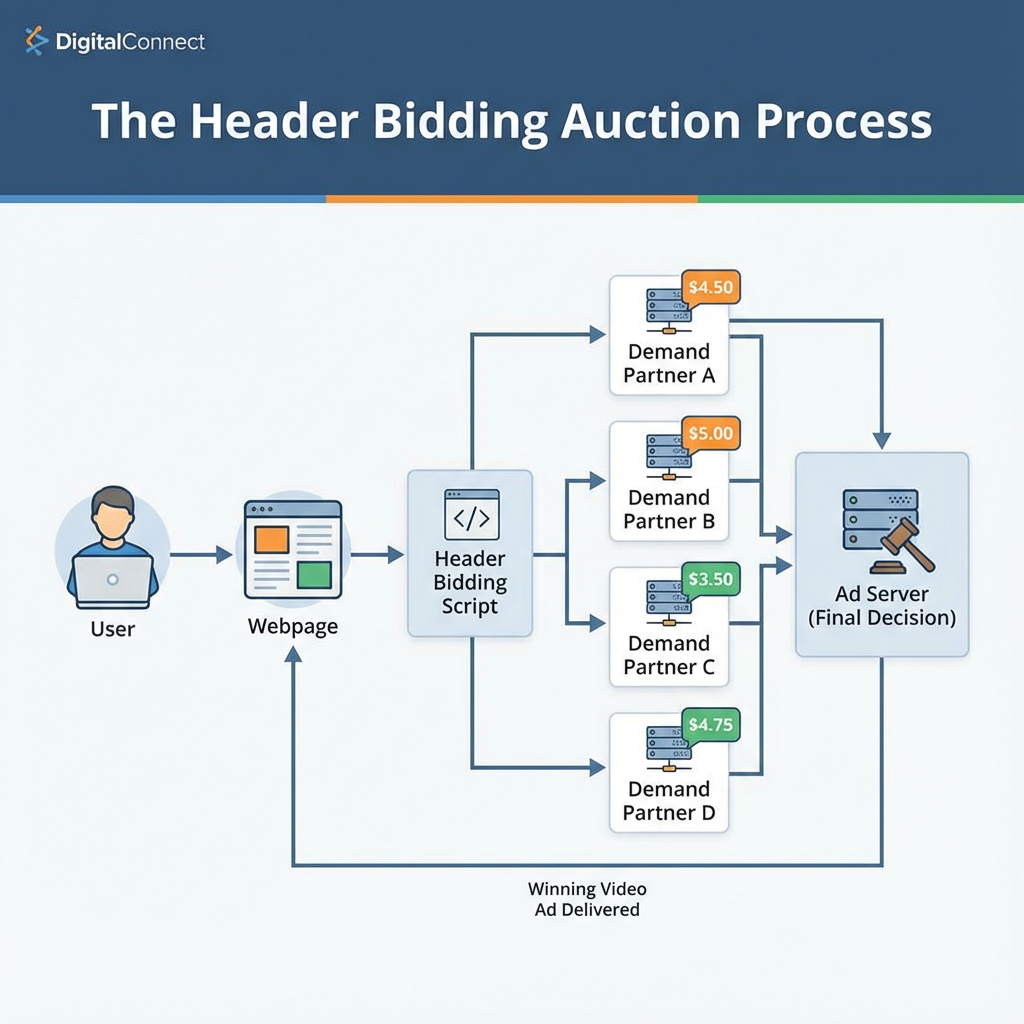
The technology gets its name because it operates through JavaScript code placed in the header section of a webpage, allowing it to execute before the page content loads. This pre-auction process ensures that multiple demand partners can bid on the same impression, creating a truly competitive marketplace.
How Header Bidding Works
The Technical Process
Header bidding fundamentally changes how programmatic auctions occur. Here's the step-by-step process:
- User visits webpage: When a user loads a page, the header bidding code executes immediately
- Simultaneous bid requests: The code sends bid requests to multiple demand partners (SSPs, exchanges, networks) at once
- Real-time bidding: All demand partners submit their bids within a predetermined timeout period (typically 1-2 seconds)
- Bid comparison: The header bidding wrapper collects all bids and determines the highest bid
- Ad server decision: The winning bid is passed to the ad server, which makes the final decision based on both programmatic bids and direct-sold campaigns
- Ad rendering: The selected creative renders on the page
Client-Side vs Server-Side Header Bidding
Client-Side Header Bidding executes directly in the user's browser. While it provides maximum transparency and control, it can impact page load times if not properly optimized.
Server-Side Header Bidding moves the auction logic to external servers, reducing latency but potentially sacrificing some transparency and control. Many publishers now use hybrid approaches combining both methods.
Benefits of Header Bidding for Publishers
Increased Revenue
Header bidding's primary advantage is revenue optimization. By enabling simultaneous competition, publishers typically see:
- 10-40% revenue increases compared to waterfall setups
- Higher fill rates due to multiple demand sources
- Better price discovery through real-time competition
- Reduced unsold inventory as more buyers compete for each impression
Enhanced Transparency
Unlike traditional programmatic setups, header bidding provides publishers with:
- Clear bid data from all participating partners
- Performance metrics for each demand source
- Real-time insights into auction dynamics
- Better understanding of inventory value
Improved Control
Publishers gain greater control over their monetization strategy through:
- Partner selection: Choose which demand sources participate
- Floor price management: Set minimum bid thresholds
- Timeout optimization: Balance revenue and page performance
- Auction rules: Customize bidding logic and preferences
Header Bidding Implementation Options
Prebid.js
Prebid.js is the most popular open-source header bidding solution, offering:
- Free implementation: No licensing fees
- Extensive adapter library: Support for 200+ demand partners
- Active community: Regular updates and improvements
- Customization flexibility: Tailor to specific needs
- Comprehensive analytics: Detailed auction insights
Proprietary Solutions
Many ad tech vendors offer proprietary header bidding platforms featuring:
- Managed services: Professional setup and optimization
- Advanced features: Sophisticated targeting and optimization
- Dedicated support: Technical assistance and troubleshooting
- Integration services: Seamless connection with existing ad stacks
Common Header Bidding Challenges
Latency Management
The biggest challenge in header bidding is balancing revenue optimization with page performance:
Solutions include:
- Timeout optimization: Finding the ideal balance between bid collection and page speed
- Lazy loading: Implementing header bidding for below-the-fold inventory
- Server-side integration: Moving auctions to external servers
- Partner performance monitoring: Removing slow or underperforming demand sources
Technical Complexity
Header bidding implementation requires significant technical expertise:
Key considerations:
- Code maintenance: Regular updates and troubleshooting
- Partner management: Adding, removing, and optimizing demand sources
- Analytics setup: Implementing comprehensive reporting
- Quality assurance: Ensuring proper auction mechanics
Revenue Attribution
Accurately measuring header bidding performance can be challenging due to:
- Multiple auction layers: Prebid auctions vs ad server auctions
- Bid landscape complexity: Various bid types and pricing models
- Cross-platform tracking: Desktop, mobile, and app measurement differences
Header Bidding Best Practices
Partner Selection Strategy
Quality over quantity: While header bidding supports multiple demand partners, too many can harm performance:
- Start with 5-8 partners: Establish baseline performance
- Monitor individual contribution: Track revenue and latency impact
- Regular performance reviews: Remove underperforming partners
- Diversify demand types: Include SSPs, exchanges, and direct buyers
Timeout Optimization
Balance revenue and performance:
- Desktop: 1000-1500ms typical timeout
- Mobile: 800-1200ms recommended
- Testing approach: A/B test different timeout values
- Dynamic timeouts: Adjust based on connection quality
Floor Price Management
Strategic floor pricing:
- Historical data analysis: Use past performance to set floors
- A/B testing: Test different floor price strategies
- Dynamic floors: Adjust based on demand patterns
- Partner-specific floors: Customize by demand source performance
Video Header Bidding Applications
Video inventory presents unique header bidding opportunities and challenges:
Instream Video
For video content, header bidding can significantly improve monetization:
- Higher CPMs: Video inventory typically commands premium pricing
- Complex creatives: Support for various video ad formats
- Player integration: Seamless integration with video players like Veedmo
- VAST compliance: Ensuring proper video ad serving standards
Outstream Video
Header bidding works particularly well for outstream video placements:
- Increased competition: More buyers for video inventory
- Format flexibility: Support for various outstream formats
- Viewability optimization: Better control over video ad quality
Industry Impact and Future Trends
Market Adoption
Header bidding adoption has grown dramatically:
- 80%+ of major publishers now use header bidding
- Billions of daily auctions processed through header bidding
- Standard practice for programmatic monetization
Emerging Trends
Server-side growth: Increasing adoption of server-side solutions for performance optimization
Mobile app integration: Expanding header bidding to in-app environments
Connected TV: Adapting header bidding for CTV and streaming platforms
First-party data integration: Leveraging publisher data for better targeting
Measuring Header Bidding Success
Key Performance Indicators
Revenue metrics:
- Revenue per thousand impressions (RPM): Primary success indicator
- Fill rate: Percentage of requests filled
- Average CPM: Price per thousand impressions
- Bid rate: Percentage of requests receiving bids
Performance metrics:
- Page load time: Impact on user experience
- Time to first bid: Auction efficiency
- Partner timeout rate: Demand source reliability
- Error rates: Technical implementation health
Analytics and Reporting
Effective header bidding requires comprehensive analytics:
- Real-time dashboards: Monitor auction performance
- Partner comparison reports: Evaluate demand source effectiveness
- Revenue attribution analysis: Understand auction dynamics
- Performance trending: Identify optimization opportunities
Conclusion
Header bidding represents a fundamental shift in programmatic advertising, enabling publishers to maximize revenue through increased competition and transparency. While implementation requires technical expertise and ongoing optimization, the revenue benefits typically justify the investment.
Success with header bidding depends on strategic partner selection, careful performance monitoring, and continuous optimization. Publishers who master these elements can expect significant revenue improvements while maintaining positive user experiences.
As the digital advertising landscape continues evolving, header bidding will remain a crucial tool for publishers seeking to optimize their programmatic monetization strategies. The technology's flexibility and effectiveness ensure its continued relevance in an increasingly competitive marketplace.
Frequently asked questions
What is the main difference between header bidding and waterfall?
Header bidding allows multiple demand partners to bid simultaneously on the same impression, while waterfall calls demand partners sequentially. This simultaneous bidding typically results in higher revenue and better price discovery for publishers.
How much revenue increase can publishers expect from header bidding?
Publishers typically see 10-40% revenue increases when implementing header bidding compared to traditional waterfall setups. The exact increase depends on current monetization efficiency, partner selection, and implementation quality.
Does header bidding slow down page loading?
Header bidding can impact page load times if not properly optimized. However, with appropriate timeout settings (1000-1500ms for desktop, 800-1200ms for mobile) and partner management, the performance impact can be minimized while maintaining revenue benefits.
What is Prebid.js and why is it popular?
Prebid.js is a free, open-source header bidding solution that supports 200+ demand partners. It's popular because it offers no licensing fees, extensive customization options, active community support, and comprehensive analytics capabilities.
How many demand partners should publishers use in header bidding?
Publishers should typically start with 5-8 demand partners to establish baseline performance. Too many partners can hurt page performance, so it's important to monitor individual partner contribution and remove underperforming sources.