Header Bidding Platform: Complete Guide for Publishers in 2024
Comprehensive guide to header bidding platforms for publishers. Learn implementation, benefits, challenges, and optimization strategies for ad revenue.
Header Bidding Platform: Complete Guide for Publishers in 2024
Header bidding has revolutionized programmatic advertising by enabling publishers to maximize ad revenue through real-time competition among multiple demand sources. As the digital advertising landscape continues to evolve, understanding header bidding platforms has become essential for publishers seeking to optimize their monetization strategies.
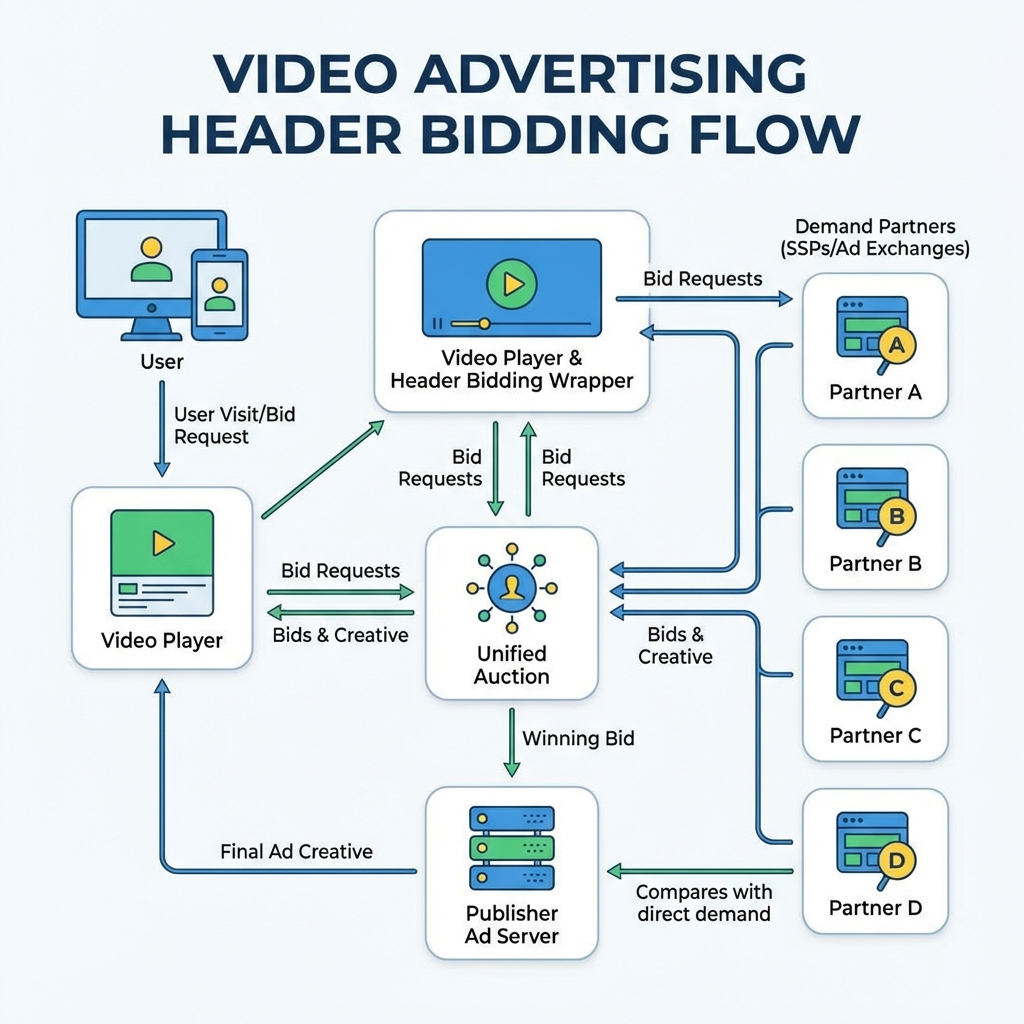
What is a Header Bidding Platform?
A header bidding platform is a unified solution that enables publishers to offer their ad inventory to multiple demand sources simultaneously before making calls to their ad server. Unlike traditional waterfall setups where ad exchanges bid sequentially, header bidding allows all participating buyers to compete for inventory in real-time, typically resulting in higher CPMs and increased fill rates.
The platform consists of several key components:
- Wrapper/Container: The core technology that manages bid requests and responses
- Demand Partner Integrations: Connections to various SSPs, ad exchanges, and demand sources
- Analytics Dashboard: Real-time reporting and performance monitoring tools
- Optimization Engine: Automated tools for timeout management, price floors, and bid optimization
How Header Bidding Platforms Work
When a user visits a publisher's website, the header bidding platform initiates the following process:
- Bid Request: The platform sends simultaneous bid requests to all connected demand partners
- Bid Collection: Demand sources respond with their bids within a specified timeout period
- Bid Evaluation: The platform evaluates all received bids and selects the highest one
- Ad Server Integration: The winning bid competes against direct campaigns in the ad server
- Ad Rendering: The final winning creative is displayed to the user
This entire process typically occurs within 200-400 milliseconds to maintain optimal page load speeds.
Key Benefits for Publishers
Increased Ad Revenue
Header bidding platforms typically deliver 20-40% revenue uplift compared to traditional waterfall setups. This improvement stems from:
- True Price Discovery: All demand sources see the same inventory simultaneously, leading to fair market pricing
- Reduced Passbacks: Fewer instances of unfilled inventory being passed down the waterfall
- Premium Inventory Access: High-value demand sources can compete for all inventory, not just remnant traffic
Enhanced Transparency
Modern header bidding platforms provide publishers with unprecedented visibility into:
- Real-time bid density and competition levels
- Demand partner performance metrics
- Revenue attribution by source
- Latency and timeout analysis
Improved Fill Rates
By connecting to multiple demand sources simultaneously, publishers typically see fill rates increase to 95%+ across their inventory. This is particularly beneficial for:
- Long-tail inventory that might not perform well in traditional waterfalls
- Geographic regions with limited local demand
- Niche content categories
Implementation Strategies
Client-Side vs Server-Side Implementation
Client-Side Header Bidding
Traditional client-side implementation involves adding JavaScript code to web pages:
// Example client-side header bidding setup
var pbjs = pbjs || {};
pbjs.que = pbjs.que || [];

pbjs.que.push(function() {
    pbjs.addAdUnits(adUnits);
    pbjs.requestBids({
        timeout: 300,
        bidsBackHandler: function() {
            pbjs.setTargetingForGPTAsync();
            googletag.pubads().refresh();
        }
    });
});
Advantages:
- Direct integration with demand partners
- Maximum transparency and control
- Established ecosystem support
Challenges:
- Potential page latency impact
- Browser limitations and ad blockers
- Complex implementation and maintenance
Server-Side Header Bidding
Server-side solutions move the auction logic to cloud servers:
Advantages:
- Reduced page latency
- Unlimited demand partner connections
- Better mobile performance
- Ad blocker resistance
Challenges:
- Reduced bid accuracy due to server-side user identification
- Less transparency in auction mechanics
- Potential cookie syncing issues
Hybrid Approaches
Many publishers now implement hybrid solutions that combine client-side and server-side bidding:
- Premium demand partners on client-side for maximum bid accuracy
- Long-tail demand routed through server-side for efficiency
- Intelligent routing based on device type, geography, or inventory value
Platform Selection Criteria
Technical Capabilities
When evaluating header bidding platforms, publishers should assess:
Demand Partner Coverage
- Number and quality of integrated SSPs and exchanges
- Geographic coverage and vertical specialization
- Direct advertiser access and private marketplace capabilities
Performance Optimization
- Adaptive timeout management
- Smart refresh capabilities for video content (solutions like Veedmo often integrate seamlessly with header bidding platforms to optimize video ad delivery)
- Advanced price floor management
- A/B testing frameworks
Analytics and Reporting
- Real-time dashboard capabilities
- Granular performance breakdowns
- Custom reporting and data export options
- Attribution modeling tools
Revenue Share and Pricing Models
Header bidding platforms typically operate under several pricing structures:
Revenue Share Model
- Platform takes 5-20% of incremental revenue
- Aligns platform incentives with publisher success
- Most common for full-service solutions
Technology Fee Model
- Fixed monthly or per-impression fees
- More predictable cost structure
- Better for high-volume publishers
Hybrid Models
- Combination of technology fees and revenue share
- Often includes performance bonuses or volume discounts
Advanced Optimization Techniques
Dynamic Price Floors
Implementing intelligent price floors can significantly impact revenue:
// Example dynamic price floor implementation
var getFloorPrice = function(adUnit, bidder) {
    var baseFloor = 0.50;
    var multiplier = 1.0;

    // Adjust based on demand partner performance
    if (bidder === 'premium-ssp') {
        multiplier = 1.2;
    }

    // Adjust based on time of day
    var hour = new Date().getHours();
    if (hour >= 9 && hour <= 17) {
        multiplier *= 1.15;
    }

    return baseFloor * multiplier;
};
Bid Landscape Analysis
Regular analysis of bid landscapes helps optimize auction dynamics:
- Win Rate Analysis: Understanding which demand partners win at different price points
- Bid Density Mapping: Identifying inventory segments with high competition
- Timeout Optimization: Balancing bid collection time with page performance
Advanced Targeting Integration
Header bidding platforms can leverage first-party data for enhanced targeting:
- Audience Segmentation: Passing user segments to demand partners for premium pricing
- Content Classification: Dynamic inventory categorization for vertical-specific demand
- Behavioral Targeting: Real-time user intent signals for bid optimization
Common Implementation Challenges
Latency Management
Page speed impact remains a primary concern:
Mitigation Strategies:
- Implement progressive timeout reduction for repeat visitors
- Use lazy loading for below-the-fold inventory
- Deploy server-side solutions for mobile traffic
- Monitor Core Web Vitals impact regularly
Demand Partner Management
Managing multiple demand relationships requires ongoing attention:
Best Practices:
- Regular performance reviews and partner optimization
- Proactive communication about inventory changes
- Standardized integration testing procedures
- Clear SLA expectations and enforcement
Data Discrepancies
Revenue attribution differences between platforms are common:
Resolution Approaches:
- Establish standardized reporting periods and metrics
- Implement reconciliation processes with major partners
- Use third-party verification tools for impression counting
- Document and track known discrepancy sources
Future Trends and Developments
Privacy-First Advertising
Evolving privacy regulations are shaping header bidding platform development:
Key Adaptations:
- Enhanced consent management integration
- First-party data activation tools
- Contextual targeting capabilities
- Privacy-preserving audience solutions
Real-Time Creative Optimization
Advanced platforms are beginning to offer:
- Dynamic creative assembly based on user context
- A/B testing of creative elements within auctions
- Cross-format creative optimization
- Interactive ad format support
Machine Learning Integration
AI-driven optimization is becoming standard:
- Predictive bid modeling
- Automated floor price optimization
- Anomaly detection for revenue protection
- Intelligent demand partner selection
Measuring Success and ROI
Key Performance Indicators
Publishers should track these essential metrics:
Revenue Metrics
- Total ad revenue and RPM trends
- Revenue uplift vs. previous setup
- Fill rate improvements
- eCPM optimization by demand source
Operational Metrics
- Page load speed impact
- Bid request success rates
- Timeout and error rates
- Demand partner response times
User Experience Metrics
- Core Web Vitals scores
- Bounce rate correlation
- Ad viewability rates
- User engagement metrics
ROI Calculation Framework
To properly evaluate header bidding platform ROI:
- Baseline Establishment: Document pre-implementation revenue and performance metrics
- Implementation Costs: Include setup fees, ongoing platform costs, and internal resources
- Revenue Attribution: Separate platform-driven uplift from organic growth
- Indirect Benefits: Factor in operational efficiency gains and competitive advantages
Conclusion
Header bidding platforms have become essential infrastructure for publishers seeking to maximize programmatic revenue in an increasingly competitive landscape. Success requires careful platform selection, thoughtful implementation, and ongoing optimization based on performance data.
The most successful publishers approach header bidding as a strategic initiative rather than a simple technology deployment. This means investing in proper setup, maintaining active demand partner relationships, and continuously optimizing based on changing market conditions.
As the advertising ecosystem continues to evolve with privacy regulations, new ad formats, and emerging technologies, header bidding platforms will remain crucial for publishers who want to maintain competitive advantage and sustainable revenue growth. The key is selecting a platform partner that not only meets current needs but can adapt and evolve with the rapidly changing digital advertising landscape.
Frequently asked questions
What's the difference between client-side and server-side header bidding?
Client-side header bidding runs auction logic in the user's browser, providing maximum transparency but potentially impacting page speed. Server-side header bidding moves auctions to cloud servers, reducing latency but with less bid accuracy due to user identification challenges.
How much revenue uplift can publishers expect from header bidding?
Publishers typically see 20-40% revenue increases when implementing header bidding compared to traditional waterfall setups. The exact uplift depends on current setup efficiency, demand partner quality, and implementation optimization.
What are the main costs associated with header bidding platforms?
Costs typically include platform revenue share (5-20% of incremental revenue), technology fees, setup costs, and internal resources for implementation and management. Many platforms use hybrid pricing models combining these elements.
How do header bidding platforms impact website performance?
Well-implemented header bidding adds 200-400 milliseconds to ad loading time. Modern platforms offer optimization tools like adaptive timeouts, server-side solutions, and lazy loading to minimize performance impact while maximizing revenue.
What should publishers look for when selecting a header bidding platform?
Key factors include demand partner quality and coverage, technical capabilities, performance optimization tools, analytics depth, pricing structure, and platform reliability. Publishers should also consider integration complexity and ongoing support quality.