Pre-Bid Programmatic: Complete Guide for Publishers & Ad Ops Teams
Master pre-bid programmatic advertising with our comprehensive guide. Learn implementation strategies, best practices, and optimization techniques for publishers.
Pre-Bid Programmatic: Complete Guide for Publishers & Ad Ops Teams
Pre-bid programmatic has transformed how publishers approach digital advertising, offering unprecedented control over yield optimization and revenue generation. This comprehensive guide explores the intricacies of pre-bid programmatic advertising, providing publishers and ad operations professionals with the knowledge needed to implement, optimize, and maximize their programmatic strategies.
What is Pre-Bid Programmatic?
Pre-bid programmatic refers to the advertising technology that enables publishers to conduct real-time auctions for their ad inventory before making ad serving decisions. Unlike traditional waterfall setups where demand sources are called sequentially, pre-bid solutions allow multiple demand partners to compete simultaneously for each impression, driving higher yields and better fill rates.
The fundamental principle behind pre-bid programmatic lies in creating a unified auction environment where all demand sources – including SSPs, ad exchanges, direct campaigns, and programmatic guaranteed deals – can compete on equal footing. This approach eliminates the inefficiencies of the traditional waterfall model and ensures that each impression is sold to the highest bidder.
Key Components of Pre-Bid Architecture
Pre-bid programmatic systems consist of several critical components working together:
- Header Bidding Wrapper: The JavaScript code that manages auction timing and bid collection
- Demand Partners: SSPs, ad exchanges, and direct programmatic buyers participating in auctions
- Ad Server Integration: Connection points that pass winning bids to the primary ad server
- Analytics and Reporting: Systems that track performance metrics and auction dynamics
How Pre-Bid Programmatic Works
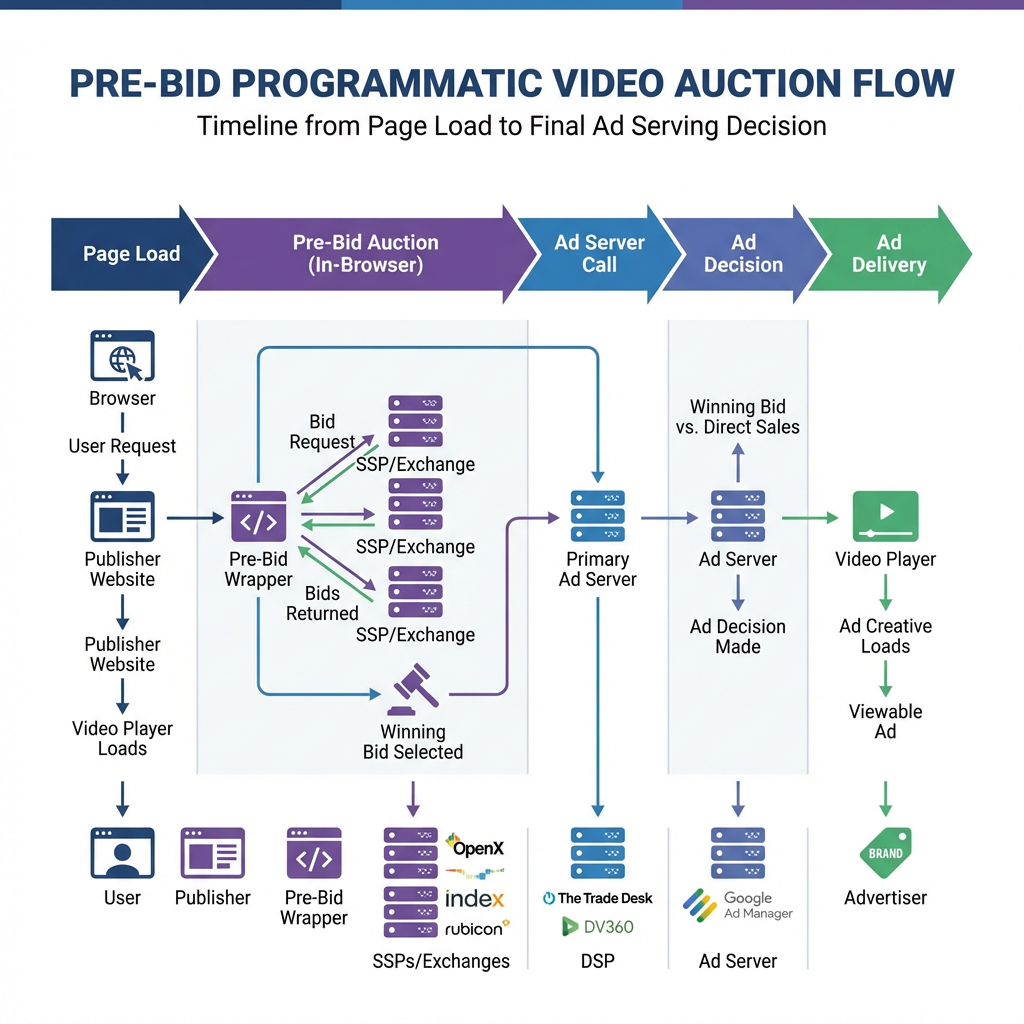
The pre-bid process follows a structured sequence that occurs within milliseconds:
Step 1: Page Load and Auction Initiation
When a user visits a publisher's page, the pre-bid wrapper immediately identifies available ad slots and initiates simultaneous auctions across all configured demand partners. The wrapper sends bid requests containing relevant inventory information, including ad sizes, content categories, and available targeting data.
Step 2: Demand Partner Response
Each demand partner evaluates the bid request using their respective algorithms, considering factors such as:
- Available advertiser campaigns
- Targeting criteria matches
- Historical performance data
- Real-time bidding dynamics
- Budget availability and pacing
Demand partners respond with bid prices and creative information within the specified timeout period, typically 1000-2000 milliseconds.
Step 3: Bid Evaluation and Winner Selection
The pre-bid wrapper collects all responses and identifies the highest bid for each ad slot. However, the process doesn't end here – the winning bids are then passed to the publisher's primary ad server, where they compete against direct-sold campaigns and other guaranteed inventory.
Step 4: Final Ad Serving Decision
The ad server makes the final serving decision based on its configured priority rules, which typically consider:
- Direct-sold campaign commitments
- Guaranteed deal priorities
- Yield optimization algorithms
- Competitive separation requirements
Implementation Strategies for Publishers
Technical Implementation Approaches
Publishers can implement pre-bid programmatic through several approaches:
Client-Side Header Bidding: The most common implementation where JavaScript code runs in the user's browser. This approach offers transparency and control but can impact page load times if not properly optimized.
Server-Side Bidding: Auction logic runs on dedicated servers, reducing browser overhead and improving page performance. However, this approach may limit access to certain targeting signals and requires more complex setup.
Hybrid Solutions: Combining client-side and server-side elements to balance performance and functionality. Critical demand partners run client-side while others operate server-side.
Demand Partner Selection and Management
Successful pre-bid implementation requires strategic demand partner selection. Publishers should consider:
Geographic Coverage: Ensure demand partners have strong advertiser bases in your target markets. Regional SSPs often outperform global players in specific territories.
Vertical Specialization: Some demand partners excel in particular content verticals or audience segments. Publishers should align their partner mix with their content strategy.
Technical Capabilities: Evaluate each partner's support for advanced features like first-price auctions, deal types, and creative formats. Video publishers, for instance, should prioritize partners with robust VAST and VPAID support, especially when implementing solutions like Veedmo for enhanced video player functionality.
Performance History: Analyze historical bid rates, fill rates, and CPMs to identify the most valuable demand sources for your inventory.
Optimization Techniques and Best Practices
Timeout Management
Proper timeout configuration balances revenue potential with user experience. Publishers should:
- Set initial timeouts between 1000-2000ms based on their audience's connection speeds
- Implement dynamic timeout adjustment based on historical partner response times
- Consider geographic variations in network latency when setting timeouts
- Monitor timeout impact on both revenue and page load metrics
Price Floor Strategies
Dynamic price floors help publishers maximize yield while maintaining healthy fill rates:
Historical Performance Floors: Set minimum prices based on historical CPM performance for specific inventory segments.
Real-Time Floor Optimization: Implement algorithmic floor adjustment based on current market conditions and demand signals.
Granular Floor Segmentation: Apply different floor prices based on geography, device type, content vertical, and audience segments.
A/B Testing Framework
Continuous testing drives programmatic performance improvements:
- Partner Mix Testing: Regularly evaluate the optimal combination of demand partners
- Configuration Testing: Test different timeout settings, floor prices, and auction parameters
- Creative Format Testing: Experiment with different ad sizes and formats to identify highest-performing options
- Targeting Strategy Testing: Evaluate the revenue impact of different data sharing and targeting approaches
Advanced Pre-Bid Strategies
Deal Management and Optimization
Private marketplace (PMP) deals within pre-bid environments require sophisticated management:
Deal Priority Optimization: Configure deal priorities to ensure high-value partnerships receive appropriate precedence while maintaining competitive dynamics.
Deal Performance Monitoring: Track deal-specific metrics including fill rates, bid rates, and revenue contribution to identify optimization opportunities.
Automated Deal Recommendations: Implement systems that suggest new deal opportunities based on historical performance patterns and market analysis.
Identity Resolution and Data Strategy
Effective pre-bid programmatic relies heavily on audience data and identity resolution:
First-Party Data Integration: Leverage proprietary audience segments and behavioral data to increase bid competitiveness and CPMs.
Identity Graph Utilization: Implement comprehensive identity resolution to improve targeting accuracy and advertiser ROI.
Privacy-Compliant Data Sharing: Develop data sharing strategies that comply with privacy regulations while maximizing programmatic performance.
Video-Specific Considerations
Video inventory requires specialized pre-bid approaches:
VAST Compliance: Ensure all demand partners support current VAST standards and can deliver compliant video creatives.
Ad Pod Optimization: For publishers using mid-roll and ad pod strategies, implement sophisticated yield optimization across multiple ad slots within content.
Cross-Screen Consistency: Develop unified pre-bid strategies that work across desktop, mobile, and connected TV environments.
Common Challenges and Solutions
Latency and Performance Issues
Pre-bid implementation can impact page performance if not properly managed:
Solution Approaches:
- Implement asynchronous loading for all pre-bid components
- Use lazy loading for below-the-fold inventory
- Optimize JavaScript code and minimize external dependencies
- Consider server-side alternatives for performance-critical implementations
Demand Partner Management Complexity
Managing multiple demand partners creates operational complexity:
Streamlined Management Strategies:
- Implement automated partner performance monitoring
- Use standardized integration approaches where possible
- Develop clear partner evaluation and optimization processes
- Create escalation procedures for technical issues
Revenue Attribution and Reporting
Accurate revenue attribution across multiple systems can be challenging:
Best Practices for Reporting:
- Implement comprehensive logging for all auction events
- Use consistent timestamp and currency standards across systems
- Develop reconciliation processes for discrepancy management
- Create unified reporting dashboards that combine data from multiple sources
Measuring Success and KPIs
Essential Performance Metrics
Publishers should track comprehensive metrics to evaluate pre-bid performance:
Revenue Metrics:
- Overall programmatic revenue growth
- CPM improvements by inventory segment
- Fill rate optimization across demand partners
- Revenue per thousand sessions (RPM)
Technical Performance Metrics:
- Average auction response times
- Partner bid rate and timeout frequency
- Page load impact measurement
- Error rates and technical issues
Operational Metrics:
- Partner performance consistency
- Deal utilization and effectiveness
- A/B test results and implementation success
- User experience impact measurements
Advanced Analytics and Insights
Sophisticated publishers implement advanced analytics approaches:
Predictive Analytics: Use historical data to predict optimal configurations and identify emerging trends.
Competitive Analysis: Monitor market dynamics and competitor strategies to inform optimization decisions.
Audience Value Analysis: Identify high-value audience segments and optimize pre-bid strategies accordingly.
Future Trends and Considerations
Privacy-First Programmatic
The evolving privacy landscape requires adaptive pre-bid strategies:
- Contextual Targeting Enhancement: Develop sophisticated contextual targeting capabilities to maintain effectiveness without third-party cookies
- First-Party Data Emphasis: Strengthen first-party data collection and utilization strategies
- Privacy-Preserving Technologies: Implement emerging technologies like Topics API and Privacy Sandbox solutions
Artificial Intelligence Integration
AI and machine learning increasingly influence pre-bid optimization:
- Dynamic Optimization: Implement AI-driven real-time optimization of floors, timeouts, and partner selection
- Predictive Modeling: Use machine learning for demand forecasting and inventory yield prediction
- Automated A/B Testing: Deploy AI systems that continuously test and optimize pre-bid configurations
Connected TV and Cross-Screen Evolution
The growth of connected TV requires evolved pre-bid approaches:
- Unified Auction Strategies: Develop consistent pre-bid approaches across all screen types
- Advanced Creative Support: Ensure compatibility with emerging interactive and shoppable video formats
- Cross-Screen Attribution: Implement sophisticated measurement approaches for multi-screen campaigns
Conclusion
Pre-bid programmatic represents a fundamental shift in how publishers approach digital advertising monetization. Success requires not only technical implementation expertise but also strategic thinking about demand partner relationships, performance optimization, and user experience balance.
Publishers who invest in comprehensive pre-bid strategies, supported by robust testing frameworks and data-driven optimization approaches, consistently achieve superior monetization results. The key lies in treating pre-bid programmatic not as a set-and-forget technology implementation, but as an ongoing optimization discipline that requires continuous attention and refinement.
As the digital advertising landscape continues evolving, publishers who master pre-bid programmatic fundamentals while staying adaptable to emerging trends will maintain competitive advantages in an increasingly complex marketplace. The investment in pre-bid programmatic capabilities pays dividends not only in immediate revenue improvements but also in building sustainable, long-term monetization strategies that can adapt to future industry changes.
Frequently asked questions
What's the difference between pre-bid and header bidding?
Pre-bid is the broader concept of conducting auctions before ad serving decisions, while header bidding specifically refers to the client-side JavaScript implementation method. Pre-bid can be implemented through header bidding, server-side bidding, or hybrid approaches.
How does pre-bid programmatic affect page load times?
Pre-bid can impact page load times if not properly implemented. Best practices include setting appropriate timeouts (1000-2000ms), using asynchronous loading, implementing lazy loading for below-the-fold ads, and considering server-side solutions for performance-critical sites.
What should publishers consider when selecting demand partners for pre-bid?
Key factors include geographic coverage, vertical specialization, technical capabilities, historical performance metrics, and compatibility with your content and audience. Publishers should also evaluate bid rates, fill rates, CPMs, and support for advanced features like deals and creative formats.
How can publishers optimize their pre-bid setup for better revenue?
Optimization strategies include implementing dynamic price floors, conducting regular A/B tests, managing timeout settings effectively, optimizing demand partner mix, leveraging first-party data, and continuously monitoring performance metrics. Regular partner evaluation and configuration testing are also crucial.
Is pre-bid programmatic suitable for video publishers?
Yes, pre-bid programmatic works well for video publishers, but requires specific considerations like VAST compliance, proper ad pod optimization, cross-screen strategy development, and ensuring demand partners support video formats. Video publishers should prioritize partners with strong video capabilities and consider specialized video player solutions.