Publisher Video Revenue: Complete Guide to Maximizing Video Advertising Income
Discover proven strategies to maximize publisher video revenue through programmatic advertising, header bidding, pre-roll ads, and CTV monetization.
Publisher Video Revenue: Complete Guide to Maximizing Video Advertising Income
Video advertising has become the cornerstone of digital publisher revenue, representing one of the fastest-growing segments in the advertising ecosystem. For publishers, understanding how to optimize video revenue streams is crucial for sustainable growth and competitive advantage. This comprehensive guide explores the strategies, technologies, and best practices that drive successful video monetization.
Understanding the Video Revenue Landscape
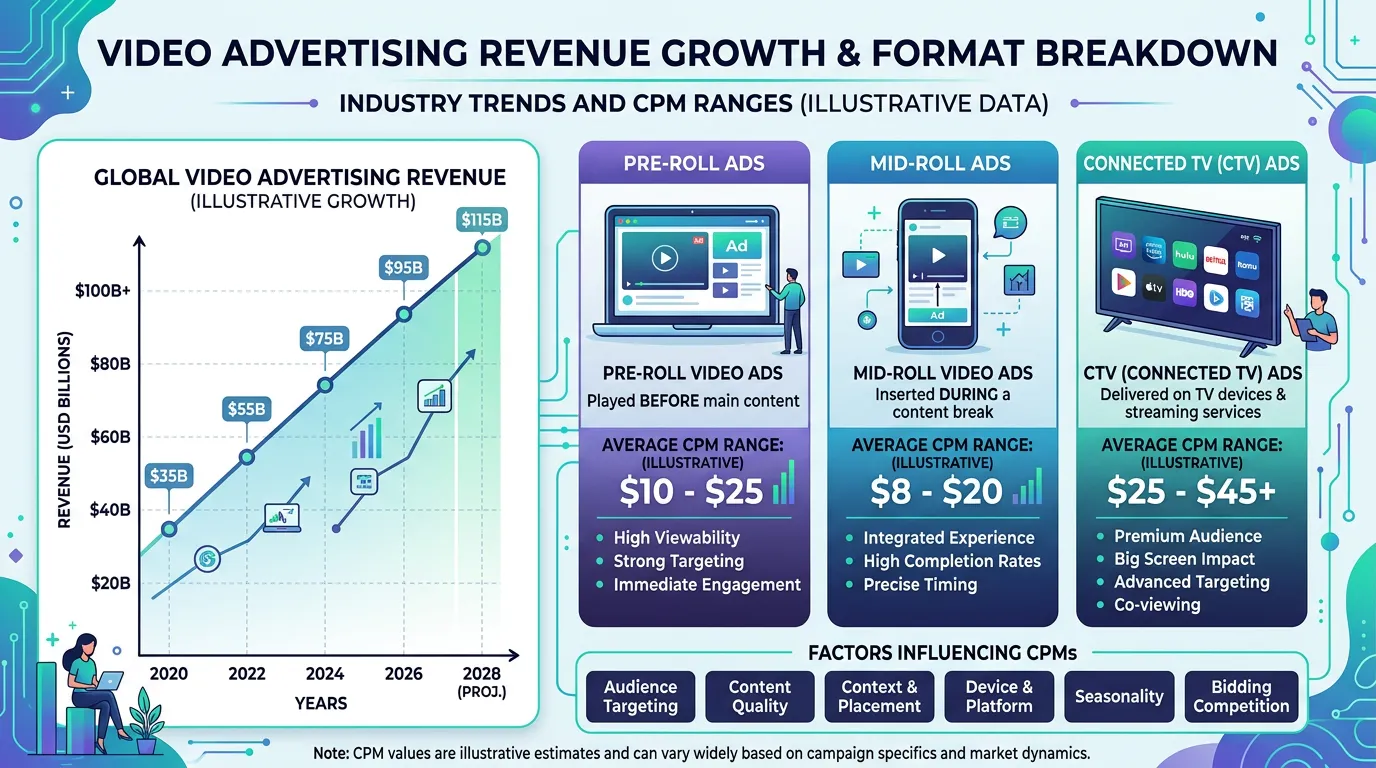
The global video advertising market continues its explosive growth, with spending expected to reach over $120 billion by 2024. This growth is driven by several key factors: increasing consumer video consumption, improved targeting capabilities, and the rise of Connected TV (CTV) and streaming platforms.
Publishers today have access to multiple video revenue streams, from traditional display video ads to sophisticated programmatic auctions. The key to maximizing revenue lies in understanding how these different monetization methods work together to create a comprehensive video advertising strategy.
Key Video Revenue Drivers
Successful video monetization depends on several critical factors:
- Audience engagement and retention rates
- Video content quality and relevance
- Ad placement optimization
- Technical implementation efficiency
- Demand partner diversity
- Real-time bidding optimization
Primary Video Monetization Models
Programmatic Video Advertising
Programmatic advertising represents the largest opportunity for publisher video revenue growth. This automated buying and selling process enables publishers to access a vast pool of advertisers through real-time bidding (RTB) auctions.
Programmatic video advertising offers several advantages:
- Scale: Access to thousands of advertisers simultaneously
- Efficiency: Automated optimization reduces manual workload
- Transparency: Real-time reporting and analytics
- Revenue optimization: Dynamic pricing based on market demand
To maximize programmatic revenue, publishers should focus on:
- Demand source diversification: Working with multiple SSPs (Supply-Side Platforms) and exchanges
- First-party data utilization: Leveraging audience insights for better targeting
- Inventory packaging: Creating premium inventory packages for higher CPMs
- Real-time optimization: Continuously adjusting floor prices and bidding strategies
Header Bidding for Video
Header bidding has revolutionized how publishers sell their video inventory by enabling simultaneous competition among demand partners before the ad server makes its decision. This client-side auction mechanism typically increases video revenue by 10-30% compared to traditional waterfall setups.
Implementation Best Practices:
- Timeout optimization: Balance between revenue and user experience (typically 1-2 seconds for video)
- Partner selection: Choose demand partners with strong video capabilities and fill rates
- Analytics integration: Monitor performance metrics across all bidders
- A/B testing: Continuously test different configurations and partners
Connected TV (CTV) Revenue Opportunities
CTV represents one of the fastest-growing segments in video advertising, with unique monetization opportunities for publishers. CTV inventory typically commands premium CPMs due to:
- Large screen viewing experience
- Engaged, lean-back audience
- Limited ad inventory (similar to traditional TV)
- Advanced targeting capabilities
Publishers can maximize CTV revenue by:
- Content quality focus: High-quality, long-form content performs better
- Audience segmentation: Leverage viewing behavior data for targeting
- Cross-device strategies: Connect CTV viewing with mobile and desktop data
- Premium inventory positioning: Package CTV inventory as premium placements
Video Ad Format Optimization
Pre-roll Advertisement Strategy
Pre-roll ads remain the most common and often highest-revenue generating video ad format. These ads play before the main video content and typically achieve completion rates of 70-85%.
Pre-roll Optimization Techniques:
- Duration optimization: 15-30 second ads generally perform best
- Skip functionality: Implement skip options after 5-6 seconds when appropriate
- Content relevance: Ensure ad content aligns with video content themes
- Frequency capping: Limit ad exposure to prevent viewer fatigue
Mid-roll Revenue Maximization
Mid-roll ads, inserted during video content, can significantly boost overall video revenue, especially for longer-form content (8+ minutes). However, they require careful implementation to avoid negatively impacting user experience.
Mid-roll Best Practices:
- Natural break points: Insert ads at logical content breaks
- Frequency limits: Generally no more than one mid-roll per 8-10 minutes of content
- Progressive timing: Avoid mid-rolls in the first 25% of video content
- Content type consideration: Works better with episodic or educational content
Advanced Ad Pod Strategies
Ad pods, multiple advertisements played in sequence, mirror traditional TV commercial breaks and can maximize revenue per impression. This format is particularly effective for CTV and longer-form content.
Ad Pod Implementation:
- Optimal pod length: 60-120 seconds total duration
- Ad variety: Mix different advertiser creative to maintain engagement
- Dynamic insertion: Use server-side ad insertion for seamless playback
- Competitive separation: Ensure competing brands don't appear in the same pod
Technical Implementation for Revenue Optimization
Video Player Technology
The choice of video player technology significantly impacts revenue potential. Modern video players should support:
- VAST compliance: Industry-standard ad serving protocol
- VPAID support: Interactive ad capabilities
- Multiple ad networks: Simultaneous integration with various demand sources
- Analytics integration: Comprehensive performance tracking
- Mobile optimization: Responsive design for all device types
Solutions like Veedmo provide publishers with advanced video player capabilities designed specifically for revenue optimization, including built-in header bidding support and comprehensive analytics.
Server-Side Ad Insertion (SSAI)
SSAI technology improves user experience by reducing buffering and loading times while enabling more sophisticated ad delivery:
Benefits of SSAI:
- Reduced ad blocking: Ads are inserted at the server level
- Improved performance: Faster load times and smoother playback
- Better analytics: More accurate measurement and reporting
- Enhanced targeting: Server-side audience data integration
Real-Time Analytics and Optimization
Data-driven optimization is essential for maximizing video revenue. Publishers should implement comprehensive analytics systems that track:
- Fill rates across demand partners
- CPM trends by audience segment
- Completion rates by ad format
- Revenue per session/user
- Viewability metrics
- User engagement patterns
Advanced Revenue Optimization Strategies
First-Party Data Monetization
Leveraging first-party data enables publishers to create more valuable audience segments and achieve higher CPMs:
- Behavioral targeting: Use viewing history and engagement metrics
- Demographic insights: Age, location, and interest-based segments
- Contextual alignment: Match ad content with video content themes
- Lookalike audiences: Expand high-value audience segments
Dynamic Floor Price Management
Implementing dynamic floor prices based on real-time market conditions can increase revenue by 5-15%:
- Historical performance analysis: Use past data to set baseline floors
- Real-time adjustment: Modify floors based on current demand
- Audience-based floors: Set different floors for different audience segments
- Time-based optimization: Adjust floors by hour, day, or season
Cross-Platform Revenue Strategies
Maximize revenue by creating cohesive monetization strategies across all platforms:
Multi-Platform Approach:
- Desktop optimization: Focus on longer ad formats and interactive elements
- Mobile prioritization: Emphasize shorter formats and vertical video content
- CTV integration: Leverage premium positioning and household-level targeting
- Social platform extension: Repurpose content for social media monetization
Measuring and Analyzing Video Revenue Performance
Key Performance Indicators (KPIs)
Successful video revenue optimization requires tracking the right metrics:
Primary Revenue KPIs:
- Revenue Per Mille (RPM): Total revenue per 1,000 impressions
- Effective Cost Per Mille (eCPM): Average revenue per ad impression
- Fill rate: Percentage of ad requests successfully filled
- Completion rate: Percentage of ads watched to completion
- Viewability rate: Percentage of ads that meet viewability standards
Secondary Engagement KPIs:
- Video completion rate: Percentage of videos watched to end
- Average view duration: How long users watch video content
- Return visitor rate: User retention and loyalty metrics
- Click-through rate: Ad engagement beyond viewing
Revenue Attribution and Analysis
Understanding revenue attribution helps optimize the entire video advertising ecosystem:
- Source attribution: Track revenue by traffic source and audience segment
- Content performance: Identify which video content generates highest revenue
- Time-based analysis: Understand revenue patterns by time of day, week, and season
- Geographic insights: Optimize for high-value geographic regions
Future Trends and Revenue Opportunities
Emerging Technologies
Several technological developments are creating new revenue opportunities:
- Artificial Intelligence: Automated optimization and predictive analytics
- Blockchain: Transparent, fraud-resistant advertising transactions
- 5G networks: Enhanced video quality and reduced latency
- Interactive video: Shoppable and gamified video experiences
Regulatory Considerations
Privacy regulations are reshaping video advertising:
- Cookieless targeting: Preparing for the deprecation of third-party cookies
- Consent management: Implementing compliant data collection practices
- First-party data emphasis: Building direct relationships with audiences
- Contextual advertising: Renewed focus on content-based targeting
Conclusion
Maximizing publisher video revenue requires a comprehensive approach that combines technological excellence, data-driven optimization, and strategic thinking. Success depends on understanding your audience, implementing the right technologies, and continuously optimizing based on performance data.
The video advertising landscape will continue evolving, with new formats, technologies, and opportunities emerging regularly. Publishers who stay ahead of these trends, invest in proper implementation, and maintain focus on user experience will be best positioned to maximize their video revenue potential.
By following the strategies outlined in this guide and continuously adapting to market changes, publishers can build sustainable, growing video revenue streams that support their long-term business objectives.
Frequently asked questions
What is the average video completion rate for pre-roll ads?
Pre-roll ads typically achieve completion rates between 70-85%, with shorter ads (15-30 seconds) generally performing better than longer formats. Skippable ads may have lower completion rates but can provide better user experience.
How much revenue increase can header bidding provide for video inventory?
Header bidding typically increases video revenue by 10-30% compared to traditional waterfall setups by enabling simultaneous competition among demand partners and reducing the dependency on a single ad server's decisioning.
What is the optimal length for mid-roll ad breaks?
Mid-roll ad breaks should typically be 60-120 seconds total duration, with individual ads lasting 15-30 seconds. The key is inserting them at natural content breaks and limiting frequency to no more than one per 8-10 minutes of content.
How do CTV CPMs compare to other video formats?
CTV inventory typically commands premium CPMs, often 2-3x higher than mobile video and 1.5-2x higher than desktop video, due to the large screen experience, engaged audience, and limited inventory availability.