VAST Viewability: Complete Guide for Publishers to Maximize Video Ad Performance
Master VAST viewability standards, measurement techniques, and optimization strategies to boost video ad revenue and improve advertiser satisfaction.
VAST Viewability: Complete Guide for Publishers to Maximize Video Ad Performance
Video advertising has become the cornerstone of digital monetization, with publishers increasingly relying on video inventory to drive revenue. However, simply serving video ads isn't enough—ensuring those ads are viewable is crucial for maximizing both advertiser satisfaction and publisher earnings. VAST viewability represents a critical intersection of technical standards and business objectives that every publisher must understand.
Understanding VAST and Viewability Fundamentals
What is VAST?
Video Ad Serving Template (VAST) is the IAB's standard for serving video ads across digital platforms. VAST XML documents contain all the necessary information for video players to display ads correctly, including creative assets, tracking pixels, and measurement parameters.
Viewability Defined
Viewability measures whether an ad had the opportunity to be seen by a user. For video ads, the Media Rating Council (MRC) and IAB define viewable impressions as:
- At least 50% of the ad's pixels are in-view
- The ad plays continuously for at least 2 seconds
- The ad has audible sound (when unmuted)
The VAST-Viewability Connection
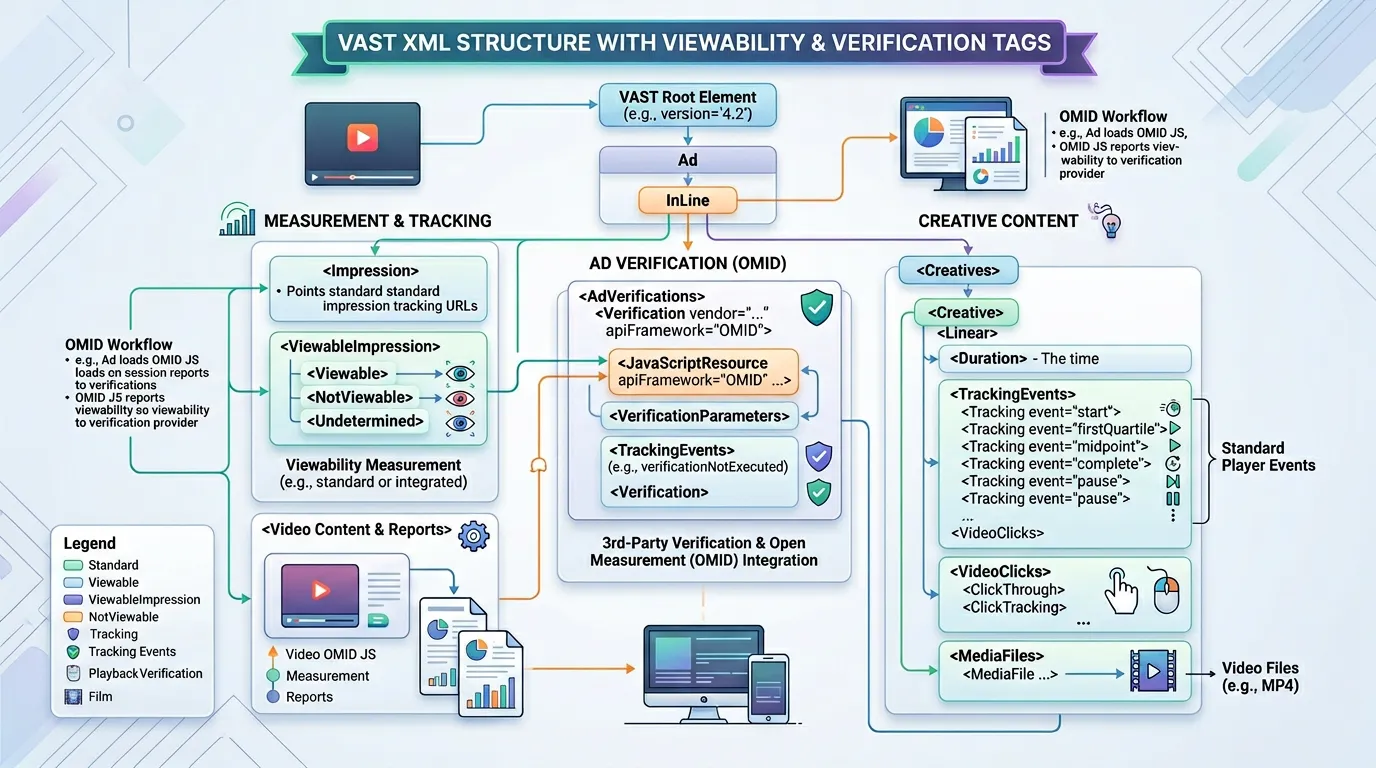
VAST tags contain specific tracking events and measurement capabilities that enable viewability verification. These include:
- Impression tracking: Fires when the ad begins loading
- Viewable impression tracking: Triggers when viewability criteria are met
- Quartile events: Track 25%, 50%, 75%, and 100% completion
- Custom tracking: Additional measurement pixels for verification
Technical Implementation of VAST Viewability
VAST 4.1 Viewability Enhancements
The latest VAST specification includes several viewability-focused improvements:
<Verification vendor="ExampleVerifier">
  <JavaScriptResource apiFramework="omid" browserOptional="true">
    <![CDATA[https://example.com/viewability-script.js]]>
  </JavaScriptResource>
  <FlashResource apiFramework="vpaid" browserOptional="false">
    <![CDATA[https://example.com/viewability.swf]]>
  </FlashResource>
</Verification>
Open Measurement Integration
Open Measurement (OM) SDK integration within VAST tags provides standardized viewability measurement:
- Unified measurement: Single SDK for multiple verification vendors
- Reduced latency: Fewer external calls improve load times
- Enhanced accuracy: Better measurement in complex environments
Implementation Best Practices
1. Proper VAST Tag Structure
Ensure your VAST responses include all necessary viewability elements:
- Verification vendor tags
- Appropriate tracking events
- Fallback measurement options
- Error handling mechanisms
2. Player-Level Optimization
Video players must support:
- DOM intersection observation
- Audio detection capabilities
- Viewport monitoring
- Focus/blur event handling
3. Ad Server Configuration
Configure ad servers to:
- Pass viewability requirements to demand sources
- Filter non-viewable inventory
- Optimize ad placement based on historical viewability data
Measuring and Monitoring VAST Viewability
Key Metrics to Track
Primary Viewability Metrics:
- Viewable impression rate: Percentage of served ads that meet viewability criteria
- Average view time: Mean duration users spend viewing ads
- Completion rate: Percentage of ads played to 100%
- Audible completion rate: Ads completed with sound enabled
Secondary Performance Indicators:
- Time to viewable: How quickly ads become viewable after serving
- Viewable CPM: Revenue per thousand viewable impressions
- Invalid traffic rate: Non-human or fraudulent viewable impressions
Measurement Tools and Vendors
Third-Party Verification:
- Integral Ad Science (IAS): Comprehensive fraud and viewability detection
- DoubleVerify: Advanced measurement with contextual analysis
- Moat (Oracle): Detailed viewability analytics and optimization insights
- HUMAN (formerly White Ops): Bot detection and invalid traffic filtering
First-Party Measurement:
Publishers can implement custom viewability tracking using:
- Intersection Observer API
- Media queries for responsive viewability
- Custom event listeners for player state changes
- Analytics platforms for data aggregation
Setting Up Viewability Dashboards
Create comprehensive monitoring systems that track:
- Real-time viewability rates across different placements
- Historical trends to identify optimization opportunities
- Buyer-specific performance for programmatic optimization
- Device and browser breakdowns for technical troubleshooting
- Geographic performance variations for regional optimization
Optimization Strategies for Publishers
Placement Optimization
Above-the-Fold Priority:
- Position primary video units in immediately visible areas
- Implement sticky or floating players for sustained viewability
- Use lazy loading for below-fold inventory to improve page performance
Responsive Design Considerations:
- Ensure video players maintain appropriate sizing across devices
- Implement mobile-optimized player controls
- Test viewability across different screen orientations
Technical Optimizations
Player Configuration:
Modern video players should support advanced viewability features. Solutions like Veedmo provide publishers with built-in viewability optimization tools, automatic measurement integration, and real-time performance monitoring to maximize ad revenue while maintaining excellent user experience.
Loading Optimization:
- Implement progressive loading for faster ad initiation
- Use preloading strategies for predictable user behavior
- Optimize creative file sizes to reduce buffering
Ad Refresh Strategies:
- Implement viewability-based refresh logic
- Set appropriate frequency caps to prevent user fatigue
- Monitor performance impact of refresh implementations
Programmatic Optimization
Supply-Side Platform (SSP) Configuration:
- Set minimum viewability thresholds for bid requests
- Implement real-time viewability prediction
- Use historical data to optimize floor prices
Header Bidding Enhancements:
- Pass viewability predictions to demand partners
- Implement viewability-based auction logic
- Monitor latency impact of viewability requirements
Common Challenges and Solutions
Technical Challenges
Cross-Domain Measurement:
Challenge: Measuring viewability across different domains and iframes
Solution:
- Implement postMessage communication protocols
- Use Safe Frame API for secure measurement
- Deploy consistent measurement SDKs across all properties
Mobile App Integration:
Challenge: Ensuring accurate viewability measurement in mobile applications
Solution:
- Integrate native app measurement SDKs
- Implement proper WebView configuration
- Test thoroughly across different app environments
Business Challenges
Balancing Revenue and Viewability:
Challenge: Maintaining high viewability without sacrificing overall revenue
Solution:
- Implement dynamic pricing based on viewability rates
- Negotiate viewability-based pricing with direct advertisers
- Focus on improving overall inventory quality rather than just filtering
Advertiser Expectations:
Challenge: Meeting increasingly stringent viewability requirements
Solution:
- Provide transparent reporting on viewability metrics
- Offer premium viewability guarantees for higher CPMs
- Educate advertisers on realistic viewability benchmarks
Industry Standards and Compliance
MRC Viewability Standards
The Media Rating Council provides authoritative guidance on viewability measurement:
- Standard viewability threshold: 50% of pixels in view for 2+ seconds
- Groupm viewability standard: 100% of pixels in view for 2+ seconds
- Premium viewability: Various custom standards for high-quality inventory
Privacy Considerations
GDPR and CCPA Compliance:
- Ensure viewability measurement respects user consent preferences
- Implement privacy-compliant data collection practices
- Provide clear disclosure of measurement practices
Cookie-less Measurement:
- Prepare for third-party cookie deprecation impact on viewability tracking
- Implement first-party measurement solutions
- Explore privacy-preserving measurement alternatives
Future of VAST Viewability
Emerging Technologies
Attention Measurement:
Beyond basic viewability, attention measurement considers:
- Eye-tracking data
- Mouse movement patterns
- Scroll behavior analysis
- Active engagement indicators
AI-Powered Optimization:
Machine learning applications for viewability include:
- Predictive viewability modeling
- Automated placement optimization
- Dynamic creative optimization based on viewability performance
Industry Evolution
Connected TV (CTV) Impact:
As CTV grows, viewability measurement faces new challenges:
- Large screen viewing behavior differences
- Household-level measurement complexity
- Cross-device viewing pattern analysis
Programmatic Sophistication:
Advanced programmatic features affecting viewability:
- Real-time viewability prediction in bid requests
- Viewability-based dynamic floor pricing
- Supply path optimization for viewability
Conclusion
VAST viewability represents a critical success factor for modern video advertising operations. Publishers who master viewability measurement, optimization, and reporting will not only satisfy advertiser requirements but also command premium pricing for their inventory.
Success requires a holistic approach combining technical implementation excellence, strategic placement optimization, and comprehensive measurement practices. As the industry continues evolving toward attention-based metrics and privacy-compliant measurement, publishers must stay ahead of emerging standards while maintaining focus on fundamental viewability principles.
The investment in proper VAST viewability implementation pays dividends through improved advertiser relationships, higher CPMs, and sustainable revenue growth. Publishers should view viewability not as a compliance requirement but as a competitive advantage in the evolving digital advertising landscape.
Frequently asked questions
What is the difference between served impressions and viewable impressions in VAST?
Served impressions count when a VAST ad begins loading, while viewable impressions only count when at least 50% of the ad is visible for 2+ continuous seconds. Viewable impressions are typically 60-80% of served impressions, depending on placement quality.
How does VAST 4.1 improve viewability measurement compared to previous versions?
VAST 4.1 introduces enhanced verification vendor support, improved Open Measurement SDK integration, better error handling, and more granular tracking events. These improvements provide more accurate viewability measurement and reduce discrepancies between measurement vendors.
What viewability rate should publishers target for video advertising?
Industry benchmarks suggest targeting 70%+ viewability rates for desktop and 60%+ for mobile. Premium publishers often achieve 80%+ viewability rates through strategic placement and technical optimization, commanding higher CPMs as a result.
Can viewability be measured in all video ad environments?
Most modern environments support viewability measurement, but challenges exist in cross-domain iframes, certain mobile apps, and legacy video players. Publishers should prioritize updating to modern, viewability-compatible infrastructure where possible.
How do privacy regulations affect VAST viewability measurement?
GDPR and CCPA require user consent for data collection used in viewability measurement. Publishers must implement compliant measurement practices, provide clear privacy disclosures, and prepare for cookie-less measurement alternatives as third-party cookies are deprecated.